Tuesday, January 24, 2012

Fitting a 1960's or 1970's Vintage Wall Telephone (Part 1).

This is an explanation of how to physically fit, or safely remove British 1960's (model No 711) or 1970's-1980's (model 741) vintage wall telephones to a wall.


1) The fist step is to locate and unscrew (half way out) the telephone case retaining screw on the bottom of the wall telephone. See the pictures below.


2) Next carefully lift the case starting from the bottom of the telephone, as it hinges at the top (however keep the telephone case parallel to the base plate). This can be tricky if you have not done it before.

TIP: It helps if you hold the telephone switch hooks down and press gently down on the vintage telephone dial while lifting the case from the bottom. See the position of my hands in the diagram below.


3) The vintage wall phone case should now lift completely off. See diagrams of the telephone below.


4) The retaining screw for the separate metal T shaped wall fitting is a single bolt/screw at the bottom, however it is hidden behind where the curly handset cord enters the telephone. So you need to slide the telephone handset cable grommet to the right, as shown below.


5) You should now be able to unscrew the single bolt that holds the T shaped bar to the vintage telephone. As shown below.


6) The telephone is hinged a the top, so simply lift from the bottom as shown above.

7) With the T shaped bar separate fit this to your wall with the appropriate screws for the type of wall it needs to fix onto.


8) Slide the curly handset cable grommet back into its original position.

9) The 741 or 711 Telephone can then be hung onto the T bracket at the top, and the retaining bolt tightened at the bottom.


10) Refit the wall telephone case, making sure the cut out in the plastic dial surround ring is in line with the metal finger stop, see below.


Tip: Holding the switch hooks down and pressing on the dial usually makes fitting the case easier.


11) Finally tighten the case retaining screw at the bottom.


12) These instruction should help, either remove these old telephones from the wall or fit them to a new position.

Thursday, October 09, 2008

Fix for 332 earpiece quite problem


An old GPO engineers maintenance trick for fixing the problem of the earpiece being quite on an early Bakelite 332 telephone is as follows:

1) Unscrew the Bakelite earpiece (anticlockwise)


2) Slide the metal diaphragm (thin metal disk) sideways off the earpiece magnets (make a note of which way round it is)


3) Make sure the two screws either side of the magnet are tight.


4) Spray the metal diaphragm (both sides) with a small amount of WD40 and wipe off with a piece of paper kitchen towel.
5) Replace the metal diaphragm (the opposite side up to the way it was removed) by sliding it sideways back onto the magnetic coils.
6) Screw the Bakelite earpiece back on.

Then try the telephone again and see if this improves the sound (works about 50% of the time).

Sunday, July 20, 2008

Safely Removing a Bakelite Mouthpiece

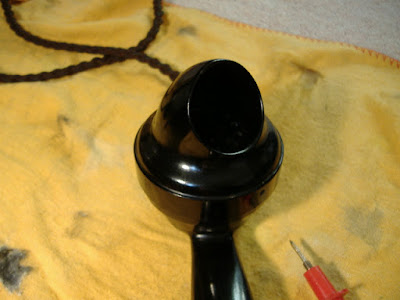
To safely remove the mouthpiece from a British Bakelite telephone handset (Type 164) used on both 200 series and 300 series Bakelite telephones, follow the following instructions.


1) Carefully insert a fine pointed instrument such as a compass point or probe from a multimeter (as shown below) into the release hole of the Bakelite mouthpiece. Be very careful not to damage the Bakelite.


2) Applying gentle pressure to the release spring inside the mouthpiece rotate the bakelite mouthpiece anticlockwise by 1/2 an inch (as shown below).


3) At this point the Bakelite mouthpiece should just lift clear of the main telephone handset.


4) The carbon granule microphone is now exposed.
5) Replacement of the mouthpiece is simple, just put the Bakelite mouthpiece on and rotate it 1/2 clockwise (if adjusted correctly it will lock onto the telephone handset).

Wednesday, May 09, 2007

Converting a British 332 Telephone

Several people have asked me for more detailed instructions about how to convert a British 332 Bakelite telephone (with a picture). 90% of the "converted telephone" are NOT converted correctly so here is the correct way to perform this conversion:

1) Remove the base plate of the telephone (using the 4 screws in the corners)
2) Remove all existing wire straps
3) Insert strap between T1 and T2
4) Insert strap between T8 and T9 (as seen on the diagram below)
5) Connect the white wire of the line cord to terminal T1
6) Connect the red wire of the line cord to terminal T9
7) Connect the blue (bell) wire of the line cord to terminal T11
8) Connect the spare green wire of the line cord to terminal T3
9) Insert a 3K resistor between terminals T11 and T12.


Hopefully the diagram should make this conversion a little easier :-)
Good luck

Wednesday, December 27, 2006

Cleaning Bakelite Telehones (and plastic phones)

After years of practice I believe the best way to clean Bakelite and plastic Telephones is as follows:
Carefully dismantle the telephone as much as possible. Then
  1. Clean the Bakelite with a good non abrasive chrome cleaner such as autochrome. Working the cleaner into the telephone in a circular motion.
  2. The next stage and most important stage is to use "paste polishing number 5" from greygate chemical products specifically designed for cleaning Bakelite telephones.
  3. Finish with a good quality "carnauda" car wax (that containing no silicones)
At each stage use plenty of elbow grease and patience. For the final polish use a clean cotton duster
Please let me know if you ever find a better way to clean Bakelite phones. or have any useful information about old British telephones.

Wednesday, June 21, 2006

GPO Phones Blog

I have created a new Antique Bakelite Telephone blog dedicated to Antique Telephones.


So if you just want to read about GPO phones please feel free to visit this old GPO phones informational site. Dedicated to nostalgic vintage British Telephones

Tuesday, April 11, 2006

Which old (British) telephones are best

A few thoughts about British Antique Telephones.

The British (1930's -1940's) era older 1/232 (pyramid phones) are rarer, but they were designed without an internal bell, which is fine as an antique, but they don't have that lovely bell sound (unless you buy a separate bell). However I love the shape. Separate bells range between £25 and £75 (depending upon type).

Because they have an internal bell and because of TV programs like "deal no deal" all the later black (1940's-1950's) 300 series telephones are very popular. Amongst the 300 series I prefer (and the most sought after is) the 312 (or 314 even rarer 3 button) with draw.

My personal favourite amongst all the working series telephones with an internal bell is the ivory 312 or 332.

In summary I believe all UK based Bakelite telephones made before the late 60's are classic and collectable.

The main thing to avoid is ITI (India Telephone Industries) 300 style telephones, these are hard to spot until you get up close, but they are VERY VERY poorly constructed and I believe are nearly worthless.

I also recommend you have at least one modern (tone dialling) phone because when you are used to bush button phones the rotary phones appear to take ages to dial the number (particularly long distance calls).

Fix for a Slow dial on 746 Telephones and 706 Telephones

Vintage 746 telephone and 706 telephone dials are lovely high quality mechanical devices (similar in many ways to antique clocks) however be...